
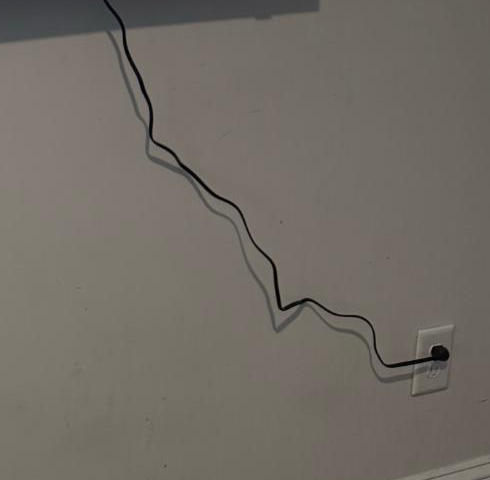
Before mounting a TV, decide where its power cord and device cables will go. The cleanest practical result depends on the outlet location, wall construction, furniture and equipment you use. Some rooms only need careful cable organization. Others are good candidates for a surface cover or a properly planned in-wall system.
Start with one firm safety rule: do not run an ordinary TV power cord or extension cord inside the wall. PowerBridge specifically warns against both, and ESFI warns against using extension cords through walls or as permanent wiring. Hiding a cord does not make it suitable for that location. PowerBridge cord warning, ESFI extension-cord safety
Map the equipment first
List what connects to the TV: perhaps a streaming box, game console, soundbar or antenna. Decide where each device will sit, then note its power and signal connections separately.
Photograph the intended TV position, existing outlets and furniture below it. Mark the approximate cable path on the photo rather than opening the wall to investigate. Tell the installer whether the mount will stay fixed or move, and whether you expect to add devices later.
This simple map helps avoid choosing a cover that is too small or placing an opening behind a bracket where it is hard to reach.
Compare the finished look
1. Tidy exposed cables
A visible, accessible route. Allow for ventilation and permitted mount movement.
2. Surface cord cover
A cover remains on the wall. Check its intended use, capacity and finish compatibility.
3. Assessed concealment
A cleaner wall after a suitable system is assessed. Power and signal cables need separate review.
Option one: organize the visible cables
If a console sits below the TV, a short, neatly arranged cable run may give you the result you want. Keep connections accessible and use suitable cable-management accessories according to their instructions. Label the device cables so a future equipment change is easier.
Leave the TV’s ventilation openings clear and allow enough cable length for any permitted mount movement. Have the final arrangement checked with the screen in its intended positions so cords do not pull on connectors or become trapped.
This is a useful choice when you want fewer changes to the room or are still deciding on the final furniture layout.
Option two: use a surface-mounted cord cover
A cord cover, sometimes called a raceway, runs along the wall’s surface. It can make a visible route look more deliberate without routing cables through a wall cavity.
Choose a product suitable for the cords, cable quantity and location involved. Legrand’s CordMate C110, for example, is an on-wall, paintable organizer intended for a single cord or cable. Its stated purpose is protecting cords and low-voltage cabling; it is not a substitute for an electrical wiring system. Larger bundles need a product with suitable capacity. Legrand CordMate details
Plan the route and corner pieces before installation. Check the product’s mounting instructions and finish compatibility. If you rent, get any required permission first; even adhesive-mounted covers can affect paint when removed.
Option three: plan an in-wall cable route
In-wall concealment needs separate decisions about signal cables and electrical power. An HDMI cable that connects your devices is not automatically suitable for installation inside a wall.
Check the cable manufacturer’s in-wall rating and its suitability for the intended route. Also verify the performance your devices need. Legrand, for example, identifies in-wall ratings and video capabilities separately on its HDMI product specifications. These are different checks, and both matter. Example manufacturer cable specifications
For power, a listed, purpose-built TV power-relocation kit may be an option where the wall and local requirements allow it. Such a system uses its specified in-wall components. Do not substitute an ordinary flexible power cord behind the drywall.
Legrand’s CMK70 is an example of a purpose-built kit with a pre-wired harness and a defined layout. Its dimensions and instructions still need to match the actual wall and outlet location. It is not a universal solution for every fireplace, wall depth or construction type. Legrand power-kit details
Have the route assessed before any holes are cut. Hidden wiring, pipes, insulation and framing can change what is practical. Don’t improvise around an obstruction or mix parts from different systems.
When to bring in an electrician
Use a licensed electrician when the plan requires a new or relocated hard-wired outlet, circuit work, or investigation of a questionable electrical supply. ESFI recommends a qualified electrician for outlet installations. ESFI outlet guidance
PR Handyman’s TV mounting service includes basic exposed-cable organization and describes separately quoted concealment options. Electrical changes need a separate scope review. For a Raleigh or Triangle home, send photos and your equipment details before purchasing a kit.
Common questions
Can the TV’s own power cord go through a brush plate?
Do not route an ordinary TV power cord through the wall. A brush plate does not turn it into in-wall-rated power wiring.
Is a cord cover the same as concealed wiring?
No. A surface cover remains on the wall. Choose it for its intended cord-management use and follow its instructions.
Can every wall hide cables?
No. Construction, obstructions, access and product requirements can limit the options. Ask for a wall-specific assessment before choosing the final method.