
Pause before the step that needs the missing part. Check that every carton arrived, compare the contents with the exact product manual, and ask the retailer or manufacturer for the correct replacement. Do not fill the gap with a similar-looking screw or continue with a fastener, support or safety component left out.
A short, organized inventory makes the support request clearer and helps an assembler understand what is ready. This guide is about resolving a parts shortage, not choosing substitute hardware or repairing a damaged joint.
1. Check all cartons and packaging
Compare the delivered boxes with the order and carton labels. An item marked as box 1 of 2 may have its hardware or another panel in the second carton. Check the packing material and separate hardware packets before declaring a part missing; keep parts for different products apart.
Photograph damaged packaging and keep labels, instructions and packaging while the issue is being resolved. If you are considering a return, check the seller's instructions before opening more packaging or altering the product. Avoid moving heavy panels alone.
2. Count against the exact manual
Match the manual to the product model, size and version. Lay out small parts on a clear surface away from children and pets. Group identical items, then compare each group with the parts list. Count panels, rails and supports as well as the hardware packets.
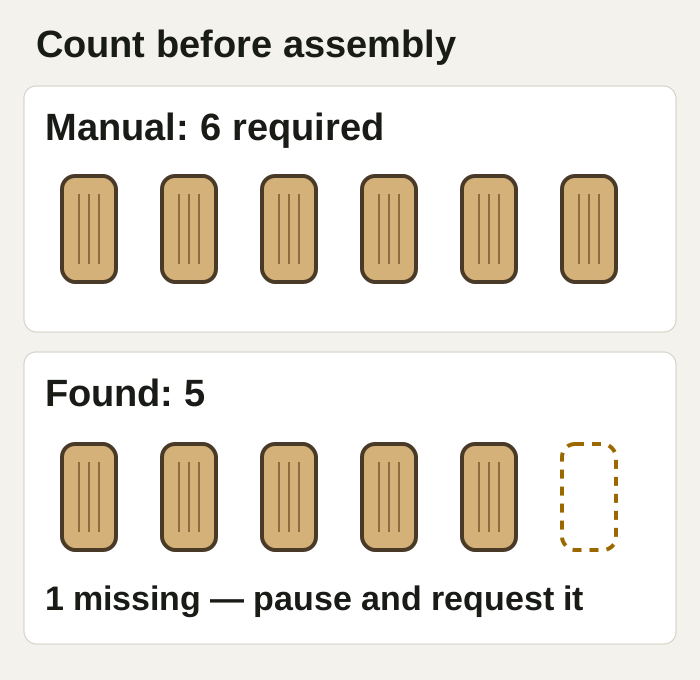
Write down the manual's part identifier, the quantity required and the quantity found. A bag letter, a manufacturer part number and the furniture model number may be different identifiers. Do not assume that two similar-looking screws are interchangeable.
If the manual is missing, obtain the correct one before making a parts request. For example, Sauder's instruction-book page uses the carton label to identify the book and provides a model-number contact option when the carton is unavailable. Other brands may use a product page or their own support process.
3. Prepare one clear parts request
- Exact product name, model and retailer link
- Order or purchase details requested by the seller, shared through its private support channel
- Cartons expected and cartons received
- Manual part identifiers and quantities missing or damaged
- Clear photos of the relevant parts list, part and packaging
- Whether assembly has started and the step where you stopped
Review photos for unrelated personal information before sending them. Our estimate-photo guide explains useful close-ups and privacy checks. Keep receipts, addresses and order details out of public comments.
“I received [number] of [number] cartons for [exact model]. The manual lists [part identifier] with [quantity] required; I found [quantity]. Assembly is [not started / paused at step]. Attached are the relevant parts-list and packaging photos. Please confirm the correct replacement or the next return/exchange step.”
4. Use the right support route
Start with the retailer's missing-item instructions and the manufacturer's support information for that product. Ask whether the issue calls for individual parts, a missing carton or a return/exchange. Confirm any availability, cost or delivery estimate with the provider; do not plan a visit around an unconfirmed replacement.
For IKEA furniture, the U.S. spare-parts page offers an online route for smaller parts such as screws, knobs and hinges, and directs customers to stores for larger furniture parts. That process is an IKEA example, not a policy for every flat-pack brand.
Sauder's replacement-parts form asks for the model and lot information from the instruction book, followed by part identifiers and quantities. Its missing-carton branch directs customers to the retailer. A missing whole box and a missing hardware piece may need different requests.
5. Keep the incomplete project safe
Do not stand up, load or use an incomplete unit that could move or fail. Do not force fittings, drill new holes or omit a brace, rail or fastener to work around the shortage. Ask the manufacturer or an appropriately qualified assembler what can safely remain unassembled while you wait.
If an anti-tip component is missing, obtain the specified solution and complete the manufacturer's anchoring requirements before use. Assembly and anchoring are separate checks: the CPSC's Anchor It! campaign emphasizes anchoring furniture with drawers, doors and shelves to prevent tip-overs. This is not a universal anchor or wall-fastener recommendation.
6. Check readiness before an assembly visit
- Correct manual and all required cartons are available
- Missing or damaged parts have been identified and the replacement plan is confirmed
- Any replacement has arrived and matches the exact model and parts list
- Hardware remains grouped with the correct product
- The workspace and safe access are ready; any partially assembled pieces are disclosed
For furniture assembly in Raleigh and the Triangle, send PR Handyman Services the product link, carton count, shortage list and current assembly status. Tell us if replacements are still pending so we can review the scope and readiness before arrangements are confirmed.
Request an estimate. If you also need to check the intended room, use the separate furniture-fit guide; correct parts do not establish that the finished piece will fit.
Quick questions
Could the missing screw be an extra?
Check the exact parts list and steps. Treat a piece as a spare only when the manufacturer identifies it that way; do not guess that a required part can be skipped.
Can a handyman supply a similar part?
Ask about the exact item, but do not assume a generic replacement is suitable. Compatibility and the manufacturer's requirements need to be resolved before assembly continues.