
Before choosing or moving a curtain rod, look at the whole path the curtain will take—not just the window. Note where the door swings, where the fabric gathers when open, and whether a heater or radiator is nearby. Check the instructions for the actual heating equipment before deciding on clearance. If the clearance is unknown, leave the question open until the manufacturer or an appropriate heating professional confirms it.
This simple room sketch can help Triangle homeowners explain the problem before buying hardware or arranging installation. It is a planning aid, not an installation template or approval to place fabric near a heat source.
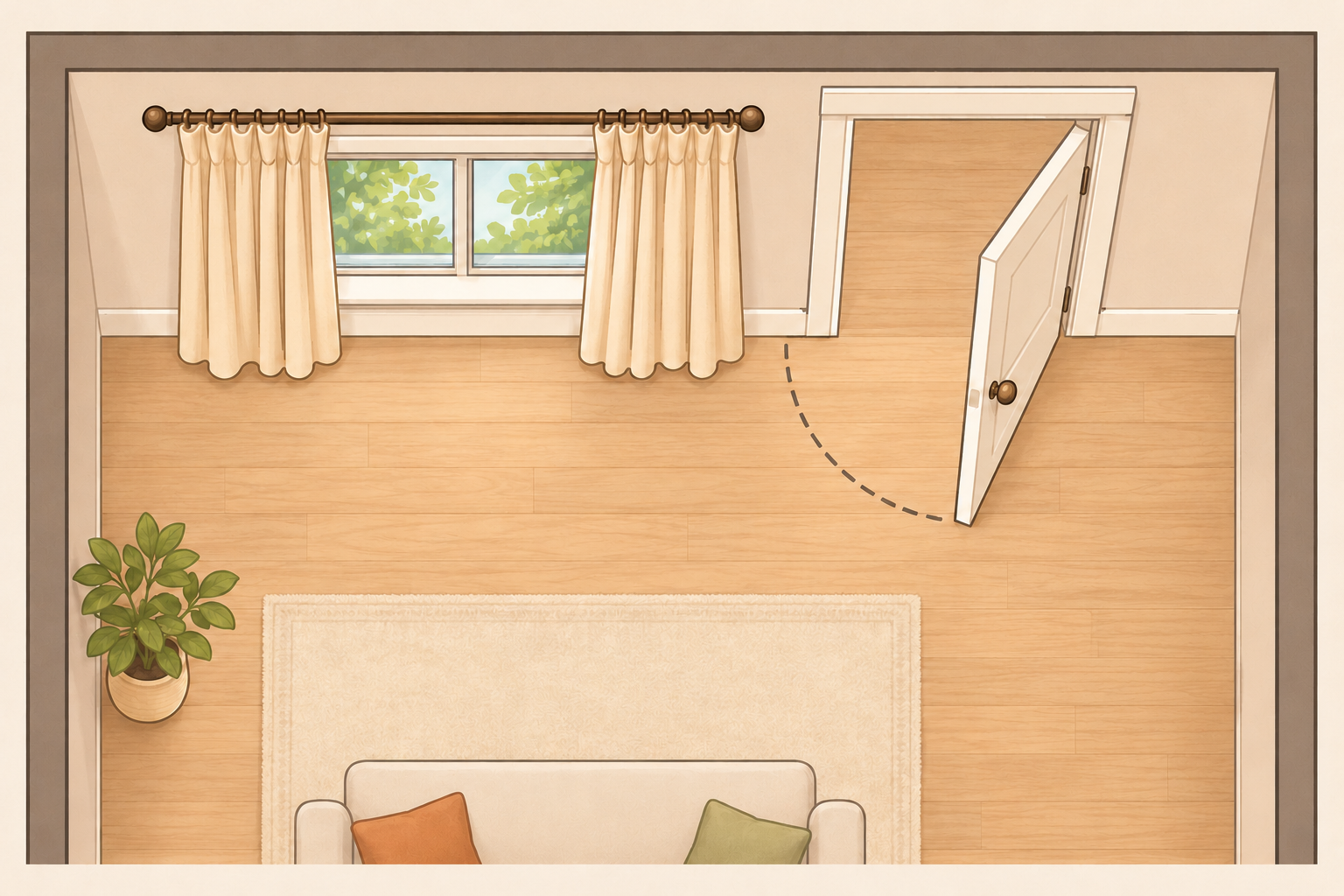
1. Watch the door's path
With the curtain safely away from any heat source, open and close the door normally. Note where the handle, door edge, or closer meets the fabric or rod. Is the curtain in the way while it hangs closed, while it is gathered open, or both? Take a photo from the room that shows the window and door together, and a close-up of the point where they meet. Don't force a sticking door or rod to recreate a problem.
2. Include the gathered fabric
Curtains need space both when they cover the window and when they are pulled aside. In a simple sketch, mark the window, the door's swing, the existing rod, and the space where the panels bunch up. Note the curtain length, width, and how it attaches to the rod, plus anything else it may catch on. Your sketch does not need to be to scale; label uncertain measurements as unknown.
Our curtain-rod measurement guide covers the window and hardware details to gather before a new rod is installed. The position that looks attractive still needs to suit the door, the actual hardware, and the room.
3. Identify the heat source before deciding on clearance
A portable space heater and a fixed radiator or baseboard heater are different products. Record what you can safely see from the room: equipment type, brand and model if accessible, and where the curtain hangs relative to it. Do not touch a hot surface, move fixed heating equipment, cover it, or rely on a generic radiator clearance.
For a portable space heater, the U.S. Consumer Product Safety Commission advises keeping all sides at least three feet away from curtains and other combustible items. It also advises against leaving portable heaters on while sleeping or running unattended in a confined space. Read the CPSC guidance.
For a fixed radiator, baseboard heater, or other installed unit, consult the exact equipment's instructions and applicable requirements; do not apply the portable-heater distance automatically. If you cannot identify the unit or its requirements, contact its manufacturer, property manager, or an appropriate heating professional before settling the curtain location. PR Handyman's curtain-rod discussion does not include diagnosing, repairing, rewiring, or moving heating equipment.
4. Check permission and curtain-cord safety
If you rent, confirm what mounting and wall changes are permitted and what the property owner expects at move-out. Our renter installation permission checklist can help you describe the proposed work.
Where young children may be present, consider cordless window coverings. CPSC warns that accessible window-covering cords present a strangulation hazard; its window-covering guidance explains the risk and why cordless options are safest. Keep cribs, beds, furniture, and toys away from accessible cords while you address the hazard.
A quick list to share
- A wide photo of the window, door, and any nearby heating unit, plus a close-up of the interference.
- Where the door or handle catches the fabric, and whether the panels are open or closed.
- Curtain length, how the panels attach, and the existing or proposed rod model and instructions, if known.
- The heating equipment type and model, if safely visible, and the relevant clearance guidance—or “unknown” if it has not been confirmed.
- Renter or property permission, if applicable, and the result you want: for example, a door that opens without catching the curtain.
If you need help planning or installing a curtain rod in the Raleigh or Triangle area, contact PR Handyman Services to discuss the room and the scope. Share the photos and product details you have; leave uncertain heating or mounting questions open for review.
Sources checked November 3, 2026: CPSC portable-heater guidance and window-covering cord guidance linked above. Door-swing mapping is a practical planning observation, not a model-specific installation instruction. Exact heating and hardware requirements depend on the products and location.