
Before overnight guests arrive, decide where a new bookcase will stand and resolve its required restraint before filling the shelves. Keep three questions separate: does it fit the room, is assembly complete under its own manual, and are the installation and loading requirements satisfied? A finished-looking empty cabinet does not answer all three.
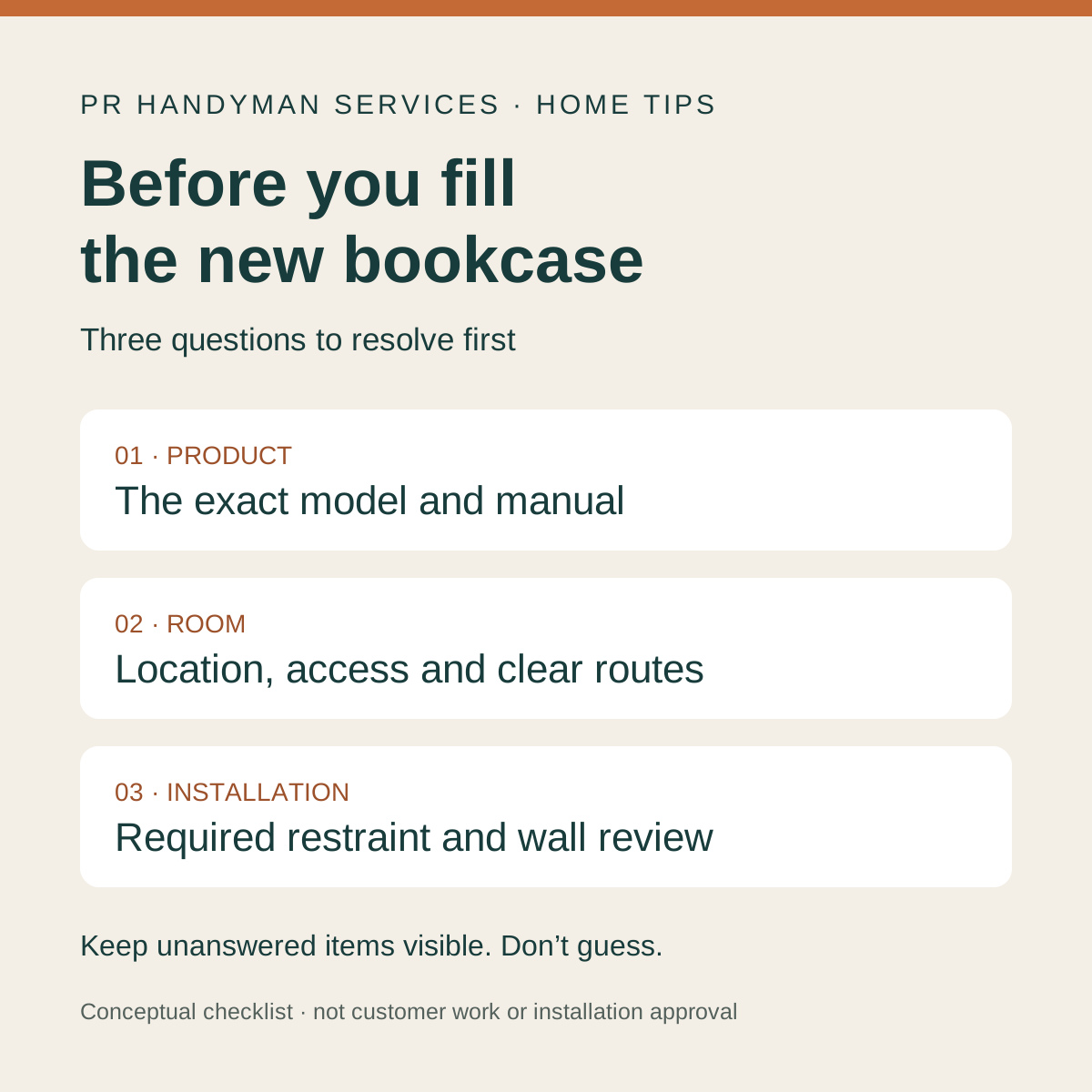
Start with the exact bookcase
Keep the model or article number, assembly manual and any separate restraint instructions together. Check that the manual matches the version you purchased, including doors, extensions or other supplied components. Keep a missing or damaged part as an open question for the seller; do not substitute a similar-looking fixing to meet a guest-arrival date.
As one model-specific example, IKEA’s BILLY manual AA-2289108-3 requires its supplied wall attachment devices and suitable wall screws and plugs, which are not included. It advises seeking professional advice when uncertain. That example is not a hardware list for another bookcase or proof that your wall is suitable.
Choose the location before assembly
Record the bookcase’s finished width, depth and height and compare them with the intended room position and the delivery route. Include skirting boards, nearby doors, outlets and the space needed to assemble the item according to its instructions. Take a wide room photo from the floor instead of moving a heavy assembled unit to test a location.
Think about how guests will reach the bed, room door and their belongings. Keep furniture and cartons out of escape routes; the U.S. Fire Administration’s escape-planning guidance recommends keeping doors and windows clear. A room sketch helps record a plan; it does not certify a clearance or replace a site assessment.
Resolve the restraint question before filling it
The CPSC Anchor It campaign emphasizes following manufacturer instructions to secure furniture and removing tempting objects that may encourage children to climb. Follow your exact bookcase’s instructions; do not treat an empty, tall or apparently stable unit as exempt.
Identify who will review the wall, required attachment system and any property permission. A wall photo alone does not establish hidden support or suitable fixings. Keep unknowns visible and arrange the appropriate assessment rather than choosing a universal anchor or improvising a spacer. Our furniture-restraint guide covers the separate information to gather.
Use one readiness card
- Product: exact model, manual and any separate restraint instructions.
- Room: intended position, finished dimensions, route and wide photo.
- Assembly: required parts accounted for; damage and missing-part questions resolved.
- Installation: restraint requirements, wall review and property permission addressed.
- Contents: model-specific shelf limits and intended items checked before loading.
- Open item: what is still unknown, who will answer it and the next step.
Shelf-load ratings and furniture tip-over restraint are different questions. Do not borrow a wall-shelf rating for a freestanding bookcase, assume an anti-tip device increases shelf capacity, or load the unit to test it. Use the exact product’s limits. Our shelf-load planning guide explains why a rating depends on its specified system and conditions.
Share the unanswered questions
If the guest-arrival date is close, keep the bookcase out of use while required assembly or restraint questions remain unresolved and choose another suitable place for belongings. Do not climb on furniture or ask a guest to steady it as a substitute for installation.
For furniture assembly around Raleigh and the Triangle, request a scope review with the product link or manual, general area, room photos and open questions. Say whether the request includes assembly, required restraint or both. The information supports a scope discussion; it is not a price, availability or completion-time promise.