
Start with the exact table model and its instructions. Some tables have a leaf designed to store inside the table; others use a separate leaf whose storage needs its own plan. Before a gathering or assembly appointment, identify the leaf, check the table’s expanded dimensions and record where the manufacturer says that particular leaf may be stored. If the model or storage method is unknown, keep it as an open question rather than assuming the leaf belongs underneath.
Identify the table and leaf
Look for the brand, model or product number and the assembly or operating instructions. Find any removable or folding sections and compare them with the exact manual. Note missing, damaged or unidentified parts without assuming a loose piece is a spare. Take a safe photo if it can be done without moving or balancing a heavy tabletop.
For example, IKEA describes one included self-storing leaf for its ROSENTORP extendable table. That is a feature of that product, not proof that a different table has the same mechanism or storage space. The exact table’s instructions govern.
Check the room in both positions
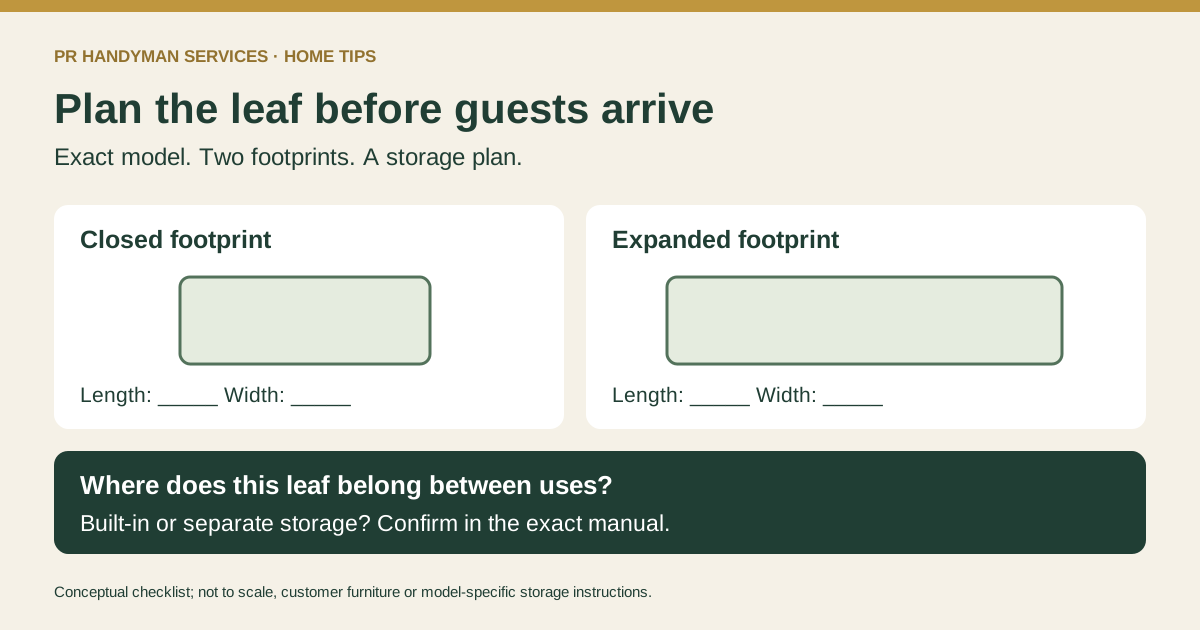
Record the table’s closed and manufacturer-listed expanded dimensions, then compare both with the intended room. Consider chair movement, walking routes and door swing in each position. If you are moving a boxed table into a new home, include the access route and assembly space. Our furniture-fit guide has a broader room and delivery worksheet.
Do not force a stuck leaf or operate an unfamiliar mechanism to make a measurement. If a part is damaged, the table shifts, or safe operation is uncertain, stop and ask the manufacturer or an appropriate professional about the exact product.
Find the permitted storage plan
Check whether the manual identifies built-in storage, a separate storage location, an orientation or a protective cover for your specific leaf. Measure a possible storage area and confirm it can accommodate the leaf as directed. Avoid assuming that a basement, attic, upright position or bag is suitable for every material and finish.
Stickley’s furniture-care guide gives its own table-leaf storage guidance, including flat storage in a controlled environment. Treat that as the manufacturer’s guidance for its furniture, not a universal rule. If your own table’s maker gives different instructions, follow the instructions for your product or ask the maker for clarification.
Save your leaf worksheet
| Question | Your note |
|---|---|
| Table brand, exact model and manual | ____ / unknown |
| Leaf type, number and condition | ____ / unknown |
| Closed and expanded dimensions | ____ / unknown |
| Room, chair and doorway questions | ____ |
| Manufacturer-approved storage method and location | ____ / ask maker |
| Parts or mechanism questions | ____ |
| Help needed and safe access route | ____ |
Keep the exact manual and any parts the manufacturer identifies for future use. Our project handover guide explains what information to retain after assembly.
Ask about assembly
PR Handyman Services offers furniture assembly, including tables and chairs, subject to review of the item, condition, location and requested work. For a Raleigh or Triangle project, request an estimate with the product link or model, the manual if available, package count, and photos of the room and access route. Tell us if the table is partly assembled, damaged or has an unfamiliar leaf; the exact scope can be discussed before scheduling.